

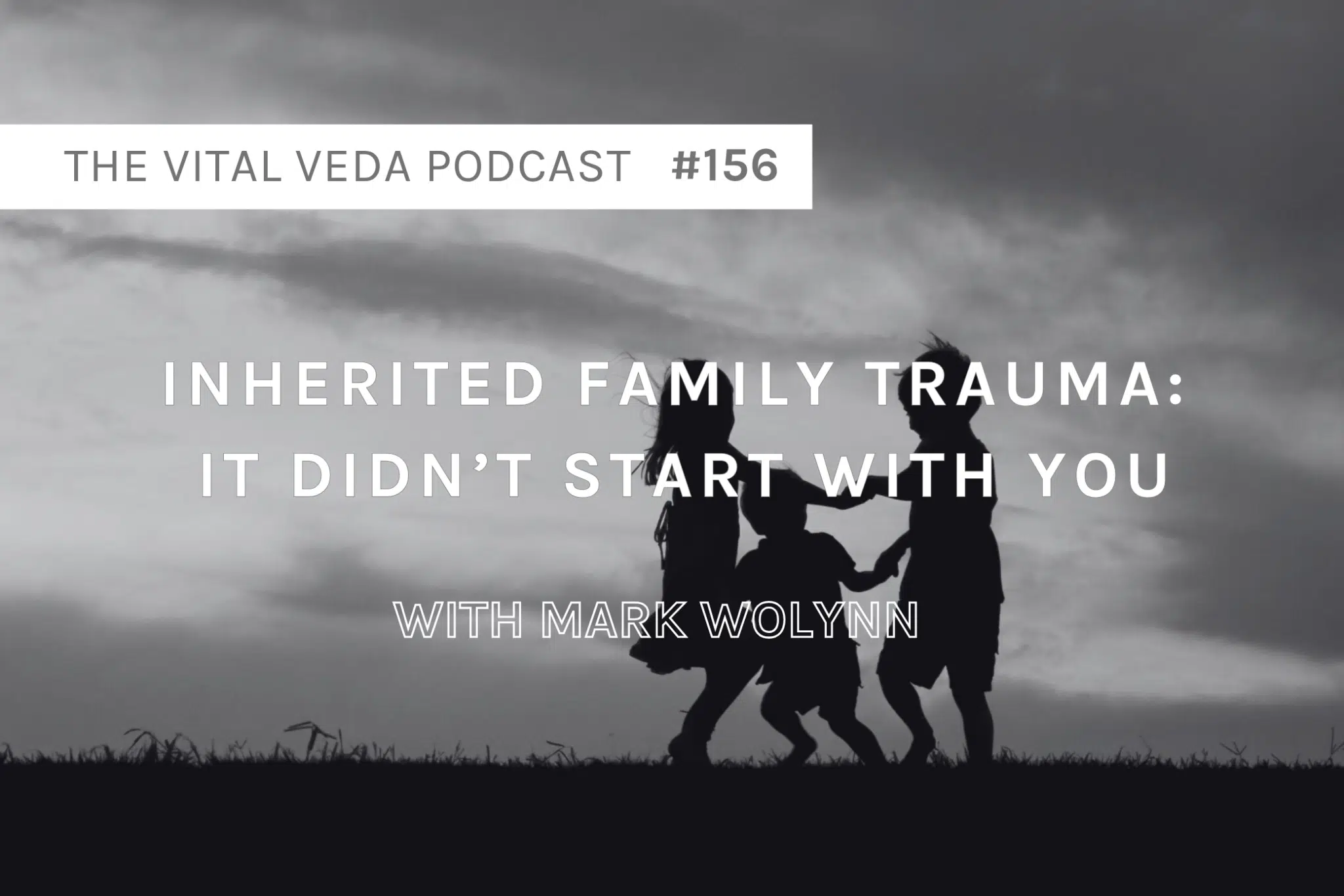
Trauma leaves an imprint, and that imprint passes down the bloodline. In the Vedas, we call it a samskara, an impression etched into us by experience and carried across generations.
Depression, anxiety, chronic pain, phobias, obsessive thoughts — the evidence suggests the root of these may lie in the traumas of our parents, grandparents, and great-grandparents. Recent research affirms that traumatic experience passes to future generations and that this emotional inheritance, hidden in everything from gene expression to everyday language, plays a greater role in our health than previously understood.
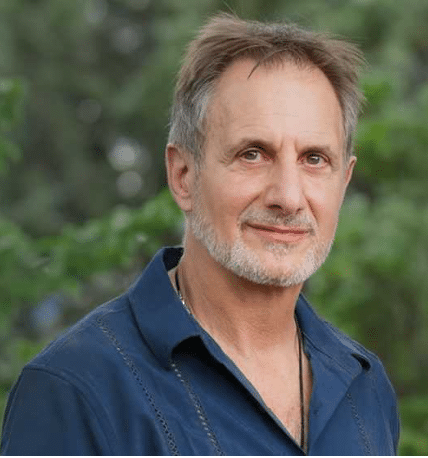
In this episode, Dylan speaks with Mark Wolynn, leading expert in inherited family trauma and author of the groundbreaking book It Didn’t Start With You. Building on decades of clinical practice and grounded in neuroscience and post-traumatic stress research, Mark developed a method to identify and break these inherited patterns.
This is not abstract theory. It is practical, body-based, and grounded in real clinical results.
Mark Wolynn is the director of The Family Constellation Institute in San Francisco and one of the world’s leading experts in inherited family trauma. His book It Didn’t Start With You: Inherited Family Trauma and How to Shift It is a landmark work in the field, praised by clinicians, therapists, and general readers alike for its accessibility and depth. His Core Language Approach draws on neuroscience, epigenetics, and somatic healing to help people locate and resolve the patterns they did not consciously create.
Inherited family trauma is not a story or a mood. It is physical, carried in the body and the cells. Our parents and grandparents are not to blame they are the access point. Understanding what happened to them is often the beginning of understanding what is happening in us.
The mouse study (Emory University, 2013) Neuroscientists taught male mice to fear a specific cherry-blossom scent by pairing it with a mild shock. They bred them. The pups, and their pups, reacted to that exact scent the very first time they encountered it even though they were never shocked and never taught to fear it. In one version using IVF, the pups never met their father at all. Yet the fear still passed. They inherited it without ever learning it.
Holocaust survivors and the FKBP5 gene (Rachel Yehuda, Mount Sinai, 2016) Rachel Yehuda studied a gene called FKBP5 the body’s stress thermostat, controlling how sensitive we are to cortisol and how quickly we can switch the stress response back off. She found an epigenetic change: a chemical tag called methylation, sitting on top of the gene like a dimmer switch, without altering the underlying DNA. The same region of FKBP5 was tagged in both Holocaust survivors and their adult children, who were born long after the war and never lived through it. It was the first time a parent’s trauma from before conception was shown to leave a measurable fingerprint on the next generation’s stress response.
Finnish men (University of Turku, 2025) Men with high levels of childhood abuse showed epigenetic changes in their sperm that could pass to future generations. Two mechanisms: DNA methylation and altered levels of non-coding RNA the same mechanisms seen in mice.
Brazilian grandmothers (2017) Grandmothers who experienced partner violence were able to pass the effects of that violence onto their grandchildren through DNA methylation.
Syria (2024) Researchers detected an intergenerational epigenetic signature of war-related violence for three generations. They could literally see it in the epigenome.
Think of Russian nesting dolls. A baby girl forms all her eggs before she is even born, while she is still developing in her own mother’s womb. When your mother was a foetus inside your grandmother, she already carried all her eggs and one of them was the egg that became you. You, your mother as a foetus, and your grandmother were all present in one body at one moment.
On the father’s side, the precursor germ cells that sperm grow from were already present when your father was a foetus in his own mother’s womb. So the beginning of your father’s line also traces back one generation earlier.
This is why Mark says: before you have children, do your work.
Patterns can be carried from family members we barely know, or never met. And beyond blood, the family system itself seems to carry unresolved material. When there is an unhealed trauma in a family a perpetrator, a victim, someone who was never mourned or acknowledged a later family member can unconsciously take on the energy of that person. Jung described it as an unresolved karma in the family system that falls on a later generation to complete.
A Cambodian boy who would pick up a hanger and say “kill, kill, kill” while running headfirst into basketball poles. His grandfather had been killed by the Khmer Rouge with a scythe to the head. The boy had never been told. When the family went to the pagoda and lit candles for the grandfather and for the families of the killers the boy handed his parents the hanger two weeks later and said: I don’t need to play with this anymore.
The specific words we use to describe our worst fears are not random. They are clues. Mark developed the Core Sentence as a diagnostic tool. The question: if your life were to fall apart, if everything went south what is your worst fear? Take it down a level: if that happened, what would be the worst part? One more level: and if that happened, what would be the worst part of that?
What emerges is usually three to seven words that cause a visceral reaction when spoken or even thought.
I’ll be all alone. I’ll be abandoned. I’ll be rejected. these tend toward an attachment direction.
I’ll do something terrible and won’t deserve to live. I’ll be sent away. I’ll go crazy. these tend toward a generational direction.
The Core Language Approach traces that language back to where it originates in the family line.
Dylan shares his own recurring dreams of Holocaust-like situations running, hiding, protecting loved ones which he had for years before understanding what they were pointing to. Three of his four grandparents are Holocaust survivors.
Mark works with dreams through lucid intention: before sleep, set an intention to enter the dream space consciously and for your highest healing. Then set an intention to remember in the morning. Dreams are likely processing inherited material whether or not we remember them, but conscious engagement deepens the work.
Some of these inherited changes appear to be adaptive, priming a child for the world the parent survived. Rachel Yehuda found that mice who were resilient to stress could pass that resiliency through their sperm. A 2020 Australian study in Psychological Trauma followed first-year paramedic students through traumatic exposures and found the majority showed moderate to high post-traumatic growth. The FKBP5 gene, which can be dysregulated by trauma, can also begin to function in an improved way as healing occurs.
Trauma is not only a wound. When it is processed, it can deepen a person.
Mark’s answer is nuanced. If we have a genuine presence practice resting in our aliveness, our vitality, our energetic core and we can stay with what comes up moment to moment, yes, healing can happen. But for most of us, the mind needs to know so the body can let go. The dark material is not a place to live, but it is a doorway. We need to go through it, not around it. Spiritual bypassing chasing only the light is real, and it keeps people stuck.
The Vedic tradition offers another angle: through working with the subtle body, the nadis, the impressions (samskara) can be addressed without full intellectual re-immersion. That is a real and valuable path. But it can tip into bypassing. The balance is the work.
Dylan raises the Vedic view that you break the cycle by no longer telling the same story. Mark’s approach finds and names the story first. Does naming free us, or can endless retelling keep us bound? Mark’s position: naming is the doorway, not the destination. We go through it to get to the aliveness beneath. The dark material is not where we camp it is what we move through on the way to feeling genuinely alive.
Step one: locate it in the body. Mark has clients imagine their mother stepping close right in front of the sternum. Eyes closed. Where does the body respond? Tightening in the chest? Nausea in the solar plexus? Numbness? This creates a somatic map of the fight, flight, freeze responses.
Step two: follow the Core Language. Use the Core Language Map from the book to trace the specific words of your fears back to where they originate.
Step three: a daily practice. Six times a day, for at least a minute each time: rest in the life-giving sensations in your core. Pulsing, tingling, warmth, expansion, softening. These are the sensations of life force. When we can genuinely rest in these rather than in the uncomfortable contractions we change our brain, calm our nervous system, and begin to shift the way our DNA expresses.
Mark’s six-point breathing practice: relax your feet. Relax your hamstrings. Open your pelvic floor. Inhale up your vagus nerve, up your midline. Relax your jaw. Exhale and expand your core, expand your heart. Integrate the fight, flight, freeze responses into your aliveness.
85 to 90 per cent of us carry some degree of attachment trauma with our mother, even if we feel close. The ideal is that parents give and the child receives and expands. But trauma in the family line often disrupts that. What your mother didn’t receive, she could not easily give. And a break in the bond with the mother is often felt as a break in the bond with ourselves a disconnection from our gut feelings, our core, our own vitality.
The personality strategies that form around this break people-pleasing, hyperindependence, being the good child, not rocking the boat are not character flaws. They are adaptations. And they are not taking us home.
It is real. When we heal, we change the way we transmit. We do not need to be completely healed before having children pacifying a condition, getting it into a genuinely good state, is meaningful and protective. And when we have positive experiences we can lean into, we grow new neural pathways, release feel-good neurotransmitters, and change how the stress genes express.
Dylan’s close: he asked his mother questions. He called his grandmother. He heard something from his mother he had never heard before about her first marriage, about something significant that had happened. He recommends the book and the workbook highly. Attending to yourself through your shared family karmas. Expanding your self-knowledge through your family line.
Rather than anger toward your parents, look behind them. What happened to them that made them that way? Develop compassion for what they did not receive. Ask them, if they are alive: what was happening when I was in the womb? What was going on with you when you were a child? Were you able to receive your mother’s love?
Getting the bigger map gives you the bigger landscape for healing.
9/11 in the womb (Yehuda, 2005): Women who were pregnant near the World Trade Center on 11 September 2001 and developed PTSD had babies with lower cortisol at age one, most markedly when exposure occurred in the third trimester.
The Dutch Hunger Winter (PNAS, 2008): People conceived during the Dutch famine of 1944 to 1945 still carried an altered methylation mark on the IGF2 gene six decades later, alongside higher rates of metabolic disease.
Research references:
Enjoyed this episode? Explore more on healing the mind, body and deeper inherited patterns.
Please leave me a comment below (I love to read every single one).
Special thanks to Rudolf Steiner and Jiddu Krishnamurti for providing content.


Time tested wisdom & an integrated healing community for you.
We pay our respects to the traditional custodians and caretakers of the lands on which we treat, teach, work and live. Vital Veda headquarters work on Bundjalung country which is now commonly known as Byron Shire, Northern Rivers NSW Australia. We also frequently work on Gadigal land, now known as Sydney, Australia. We recognise the traditional custodians have never ceded sovereignty and their culture remains strong and holds supreme wisdom for all of humanity to enjoy.
*This information and these statements have not been evaluated by the Therapeutic Goods Association or the Food and Drug Administration. This information and these products are not intended to treat, diagnose, cure or prevent any disease.
Disclaimer: The entire contents of this website are based upon the opinions of Dylan Smith. This information is in no way to be construed as a substitute for consultation with a licensed health professional. It is not intended as medical advice. They are intended as sharing of knowledge and information from the research and experience of Dylan Smith and his community. Dylan Smith encourages you to make your own health care decisions based upon your research and in partnership with a qualified health care professional.
© 2026 – Vital Veda. All Rights Reserved.
Occasionally get notified about new offerings, special deals, wisdom and more
Occasionally get notified about new offerings, special deals, wisdom and more
Occasionally get notified about new offerings, special deals, wisdom and more
Occasionally get notified about new offerings, special deals, wisdom and more