

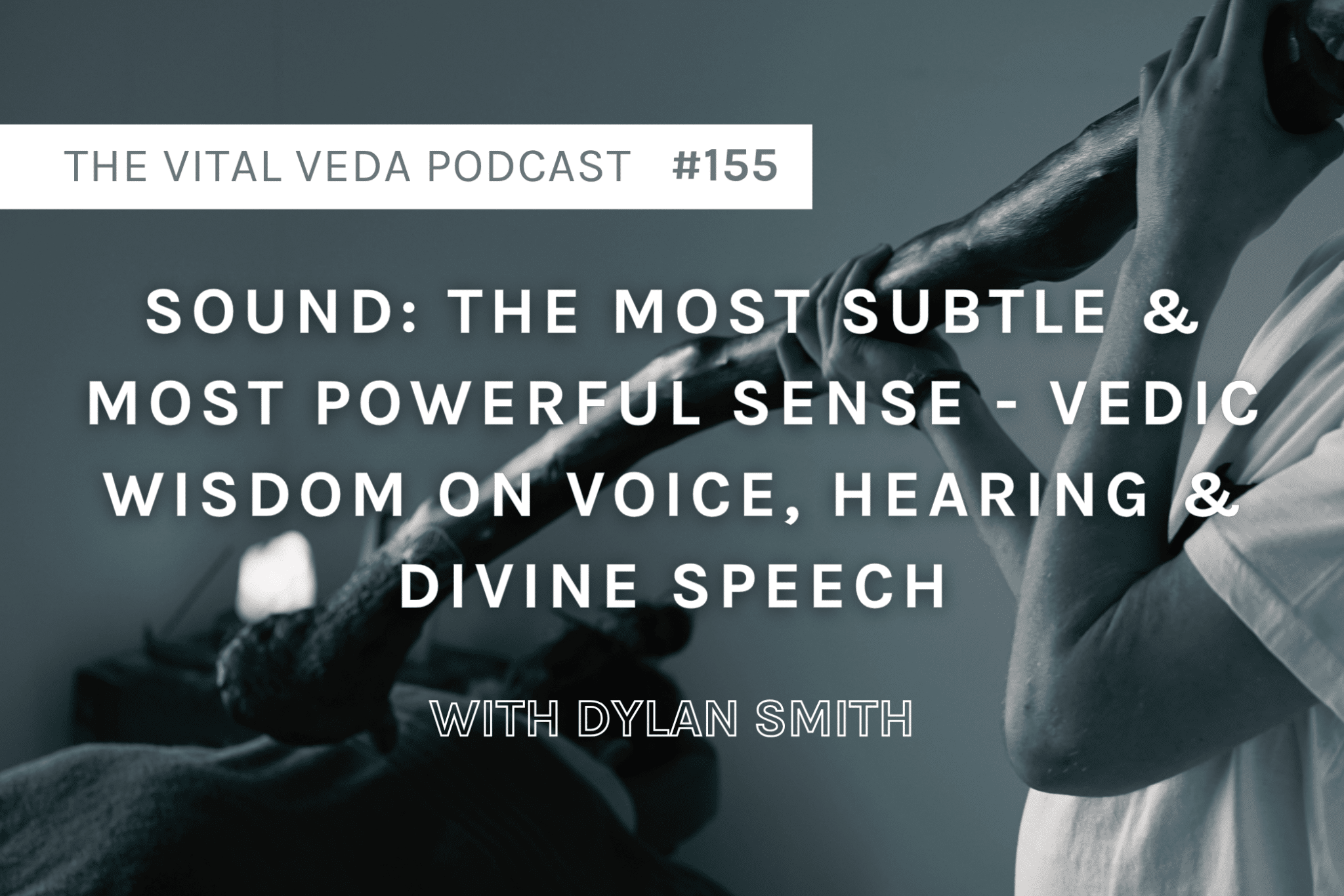
Sound is described in the Vedas as the most subtle of all the senses.
And because it is the most subtle, it is also the most powerful.
What you speak, how you speak, and what you allow yourself to hear shape the health of your sense organs — your indriya — which are directly correlated with the quality of your mind and the depth of your consciousness.
This is not a passing idea. It is formative. Sensory activity is directly correlated with who you become and how you show up in the world.
In this episode of the Vital Veda Podcast, recorded live at a sound healing evening in London this May, Dylan Smith was invited to open the night with a talk laying out the Vedic science underneath the experience, before the healing itself began.
Joining him in the room was Anu, an Ayurvedic practitioner and the founder of Jivita Ayurveda in London, a colleague Dylan collaborates with whenever he consults and teaches there.
Together they moved from the physics of sound to the philosophy of speech. From the physical care of the ears in Ayurveda, all the way to Vāk Siddhi — the rare human capability in which what you speak begins to come true.
This is not a heavy clinical episode. It is an initiation into a way of relating to sound, voice, and hearing that most people have never considered. Once you hear it, you won’t unhear it.
In Vedic knowledge, the five senses are ranked by subtlety. Sparśa — touch — is considered the king of the senses according to the Caraka Saṃhitā. But sound operates at a subtler level still, and that is precisely where its potency lives.
The more subtle a thing is, the more pervasive and powerful its influence on consciousness.
The four Vedas — Sāma, Ṛk, Yajur, and Atharva — are themselves composed entirely of sound. The Sāma Veda in particular is the Veda of music and celestial vibration.
Sadyādi phalaṁ gāndharvāḥ: celestial sounds create divine results.
From the Upaniṣads and the Mahābhārata comes one of the most quietly radical teachings on human speech:
This is not a teaching about avoiding honesty. It is a teaching about timing, tone, and the condition of the heart that receives. Truth cannot guide or teach if the heart is hurt by it — the heart must be confident and open to grow.
Speak truth, but speak it sweetly. And if neither you nor the other person are ready for a particular truth, do not force it. Find what is positive and true, and speak that first.
Ayurveda offers precise protocols for maintaining and deepening the health of the auditory sense:
Śravaṇa is not simply the act of listening. In the Vedic framework, it is the cultivation of a receptive, refined auditory faculty capable of perceiving subtler and subtler levels of sound, including, at the highest development, celestial sound itself.
The outward voice engages the physical world. The inner voice, the silent repetition of mantra, penetrates directly into consciousness.
This is why the most potent mantra practice is not spoken aloud, but held within. The subtler the sound, the deeper its reach.
Vāk Siddhi is the siddhi — the extraordinary human capability. In which what you speak begins to come true. It is cultivated over years through purity of speech, purity of living, and dedicated sādhana.
The governing force behind it is Udāna Vāta, the upward-moving vital force associated with expression, speech, and Sarasvatī, the Vedic deity of knowledge, language, and sound.
Enjoyed this episode? Explore more conversations on sound, mantra, and sacred voice.
Please leave me a comment below (I love to read every single one).
Special thanks to Rudolf Steiner and Jiddu Krishnamurti for providing content.


Time tested wisdom & an integrated healing community for you.
We pay our respects to the traditional custodians and caretakers of the lands on which we treat, teach, work and live. Vital Veda headquarters work on Bundjalung country which is now commonly known as Byron Shire, Northern Rivers NSW Australia. We also frequently work on Gadigal land, now known as Sydney, Australia. We recognise the traditional custodians have never ceded sovereignty and their culture remains strong and holds supreme wisdom for all of humanity to enjoy.
*This information and these statements have not been evaluated by the Therapeutic Goods Association or the Food and Drug Administration. This information and these products are not intended to treat, diagnose, cure or prevent any disease.
Disclaimer: The entire contents of this website are based upon the opinions of Dylan Smith. This information is in no way to be construed as a substitute for consultation with a licensed health professional. It is not intended as medical advice. They are intended as sharing of knowledge and information from the research and experience of Dylan Smith and his community. Dylan Smith encourages you to make your own health care decisions based upon your research and in partnership with a qualified health care professional.
© 2026 – Vital Veda. All Rights Reserved.
Occasionally get notified about new offerings, special deals, wisdom and more
Occasionally get notified about new offerings, special deals, wisdom and more
Occasionally get notified about new offerings, special deals, wisdom and more
Occasionally get notified about new offerings, special deals, wisdom and more