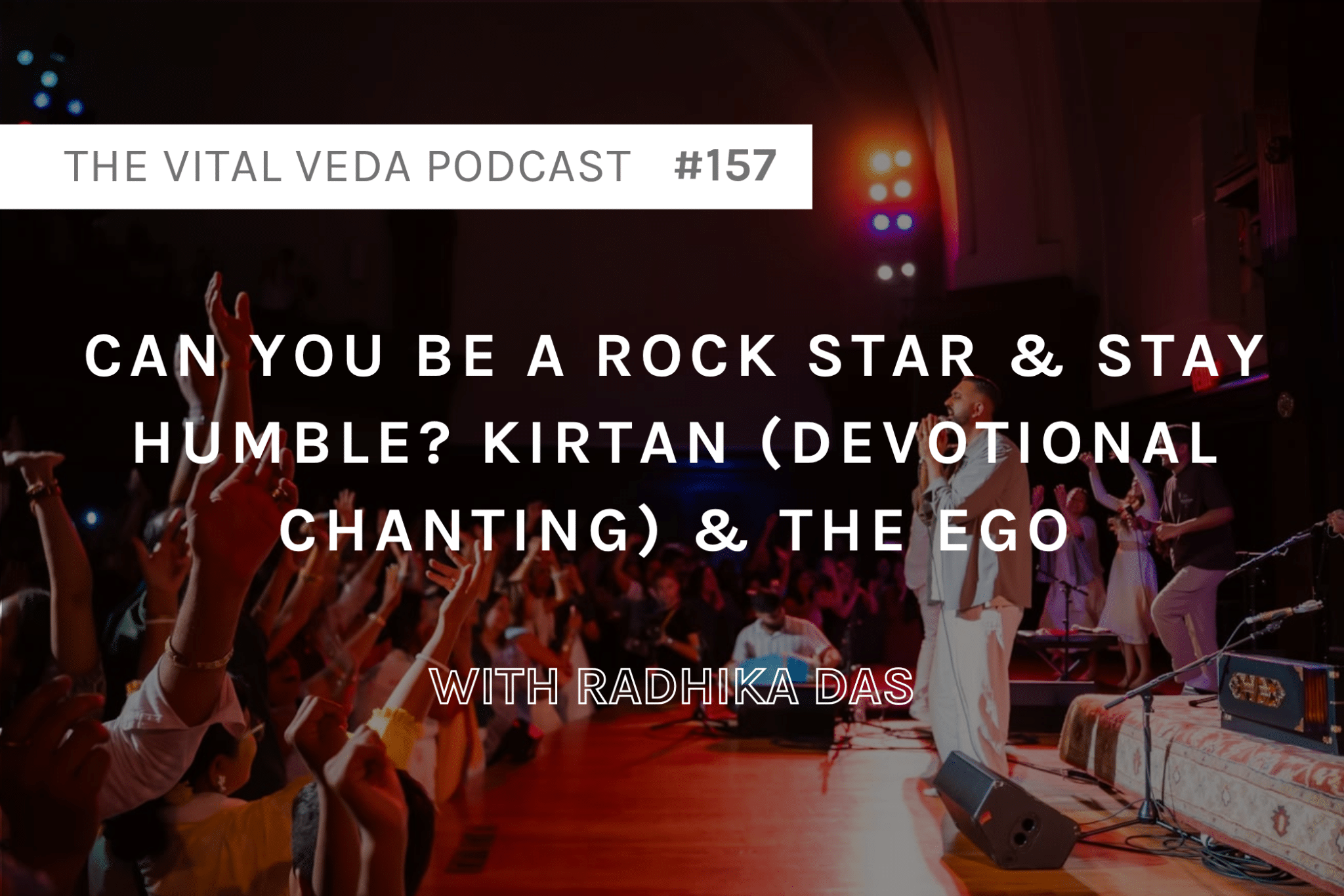


Radhika Das has taken kirtan into the British Museum, filled London’s Union Chapel, and led a crowd of fifteen thousand in New Delhi. His name was given to him by his spiritual teacher: Radhika Ranjan Das, shortened for Western audiences to Radhika Das. Radhika is the vocative of Radha, the feminine divine of the bhakti tradition, who “teaches how to serve and how to devotionally love God.” Ranjan means one who pleases. Das means servant.
In this episode, Dylan speaks with Radhika Das about the rapid rise of his kirtan career, staying grounded inside a devotional practice built for public witness, and what it takes to be, in his own words, less absorbed in “me, me, me” while thousands of people are watching.
Radhika Das is a kirtan artist within the bhakti tradition, known for taking devotional chanting to unconventional stages, including the British Museum, Union Chapel, and a crowd of fifteen thousand in New Delhi. His name, Radhika Ranjan Das, was given to him by his spiritual teacher after he committed to the path of bhakti and kirtan. Radhika comes from Radha, the feminine divine who, in his words, “teaches how to serve and how to devotionally love God.” Ranjan means one who pleases. Das, the part of the name he says matters most, means one who serves.
He hosts the podcast For Soul’s Sake and is the author of Mantra Meditation, a collection of mantras meant to bring readers back to joy, connection and calm.

Radhika Das wasn’t born with the name. It was given to him by his spiritual teacher after he committed to the path of bhakti and kirtan.
“Radhika is the name of the feminine divine,” he explains. “She’s the goddess, the ultimate mother according to the bhakti tradition, and she teaches how to serve and how to devotionally love God.” Ranjan means one who pleases, so Radhika Ranjan is one who is simply trying to please Sri Radha. The most important part of the name, he says, is the title at the end: Das, one who serves.
He shortened it for audiences outside India. “I kept it simple because I knew the West would find Radhika Ranjan too much to roll off the tongue,” he says. “So I shortened it to Radhika Das.”
Radhika Das’s public profile has grown quickly. “The rise in terms of public awareness has shot up in the last, I’d say, three years,” he says, though it followed years of playing to nearly empty rooms. Sold-out kirtans, a world tour and his podcast For Soul’s Sake have followed.
Asked how he manages his ego as that growth compounds, he describes it as ongoing, not solved: “It’s not a one-time fix moment… it starts with an awareness of where one’s ego is at any given moment.” His anchor is remembering where his knowledge and his music actually come from. “If I can remember that the origin of those was not myself, then I think it’s a good way to anchor oneself away from the sense of pride and false ego.”
He offers a line he returns to often: “Humility doesn’t mean to think less of yourself. Humility means to think about yourself less.” He’s candid that he doesn’t always succeed. “Do I experience moments of absorbed false ego? Of course, I’m a human being… I think it would be foolhardy of me to aim for a life free from false ego. I just don’t think it’s going to be possible for me, if I’m honest. I’m too flawed.”
One practice that helps is keeping udipans, spiritual reminders, in view. He points to the murtis of Hanuman near his desk. “As soon as I see Hanuman, I remember: who gave him the strength to lift the mountain, to throw boulders in the ocean to build the bridge? If he can remember, then I should also remember.”
With two young children at home, Dylan asks how Radhika balances touring, business and family. His answer pushes back on the premise: “I don’t think there is a balance, you know. I just think it’s about noticing when you’re imbalanced.”
When he’s home from touring, family comes first. “I tell everyone, please don’t disturb me. I’m not taking any meetings, I’m not taking any calls. Just let me be with my kids.” He also keeps a boundary around how much of the world he actually sees while on tour. “When the service finishes, I go home… I’d rather experience that with my kids when they get older,” he says, describing trips where he flew across the world for only a handful of days without sightseeing.
He’s honest that he doesn’t always get it right. “I’ve messed up many times, and I’m learning from those mess-ups.” One practice he holds to is messaging his wife first after a concert, before the adrenaline of the show pulls him toward people who might simply flatter him. “The person you want to talk to about that is not immediately someone that’s going to fan your flame… my wife’s been that for me many, many times.”
Dylan raises a verse from the Bhagavad Gita, yoga-sthaḥ kuru karmāṇi, established in being, then perform action, and asks whether kirtan alone is Radhika’s daily anchor, or whether something else is doing that grounding work underneath it.
Radhika points to practices described by the acharyas of the bhakti tradition: shravanam (hearing) and smaranam (remembrance, or meditation) matter to him as much as the chanting itself. He recalls advice from his own teacher: “For every one hour you sit in front of a microphone and try to speak and share, spend two hours away from it, absorbing yourself, hearing, and receiving… listening to great teachers and elders.”
He illustrates the risk of skipping that inner work with a story about a monk who chanted for two hours every morning, apparently deep in practice, until one day he simply stopped coming. When a friend asked why, the monk admitted: “For two hours I was thinking about all other things but Krishna. My mind was going all other places… My mouth was moving, but my mind was elsewhere.”
“Anything good that comes out of my mouth, or anything good that people see in me, is my meditation, my teachers, my gurus, my hearing,” Radhika says. “And anything bad that people see is definitely me.”
Dylan names something he’s noticed across the Hare Krishna community: people are often self-deprecating about how little japa, mantra repetition, they actually do. Radhika doesn’t dismiss the observation. “It’s definitely something the Hare Krishna movement’s embarrassed about, how little the Hare Krishnas actually chant Hare Krishna.”
He admits that a year and a half ago, he found his own japa a chore, chanting while watching TV or scrolling Instagram, because his mind had nothing to engage with. “I think the next step for most devotees… is to see where’s your mind. Can you engage your mind in an attractive awareness?” He’s careful not to be harsh on people who show up anyway, even distracted: “If you go to a hospital and someone’s getting treated, you don’t laugh at them for getting treatment… I’d rather say, well done, here’s the treatment, it’ll take some time.”
Asked for a story involving Hanuman, Radhika describes a trip to a circus-style park in Jaipur with a group of friends, including a couple who wandered off on their own. When the group regathered to leave and the couple hadn’t returned, and security began pushing everyone toward the exit, Radhika felt a strong pull to go back. He jumped a highway barrier and a security fence to re-enter the park.
He found his friend sitting with his head in his hands. His friend told him that, moments earlier, he and his partner had chanted Om Hanumate Namaha, the mantra associated with Hanuman as the finder of lost things, after realising neither of them had a phone with battery or any money. “As soon as he chanted the mantra, there I was, standing right in front of him,” Radhika says.
Radhika is the author of Mantra Meditation, a collection of eight or nine mantras, including Om Namah Shivaya, Om Hanumate Namaha and the Hare Krishna maha-mantra, meant to bring readers “back to joy, connection and calm.”
Dylan asks about the responsibility of sharing mantras with readers who haven’t received them through a formal initiation. Radhika’s answer centres on intent rather than lineage: “I’ve come to the conclusion that the goal of chanting is to find yourself madly in love with the Supreme… If I can sincerely and with integrity try my best to bring people to that point, then I don’t think I’m going to get punishment by my Lord.”
He’s candid that not everyone who chants these mantras will land in his own tradition, and says he’s at peace with that. “I think it’s foolhardy to try and convert every single human being into the same train of thought… Shouldn’t we just try to uplift those who are swimming in an ocean of material absorption? That’s what I’m trying to do. That’s my goal.”
Enjoyed this episode? Explore more on bhakti, kirtan and devotional practice.
Please leave me a comment below (I love to read every single one).


Special thanks to Rudolf Steiner and Jiddu Krishnamurti for providing content.


Time tested wisdom & an integrated healing community for you.
We pay our respects to the traditional custodians and caretakers of the lands on which we treat, teach, work and live. Vital Veda headquarters work on Bundjalung country which is now commonly known as Byron Shire, Northern Rivers NSW Australia. We also frequently work on Gadigal land, now known as Sydney, Australia. We recognise the traditional custodians have never ceded sovereignty and their culture remains strong and holds supreme wisdom for all of humanity to enjoy.
*This information and these statements have not been evaluated by the Therapeutic Goods Association or the Food and Drug Administration. This information and these products are not intended to treat, diagnose, cure or prevent any disease.
Disclaimer: The entire contents of this website are based upon the opinions of Dylan Smith. This information is in no way to be construed as a substitute for consultation with a licensed health professional. It is not intended as medical advice. They are intended as sharing of knowledge and information from the research and experience of Dylan Smith and his community. Dylan Smith encourages you to make your own health care decisions based upon your research and in partnership with a qualified health care professional.
© 2026 – Vital Veda. All Rights Reserved.
Occasionally get notified about new offerings, special deals, wisdom and more
Occasionally get notified about new offerings, special deals, wisdom and more
Occasionally get notified about new offerings, special deals, wisdom and more
Occasionally get notified about new offerings, special deals, wisdom and more