


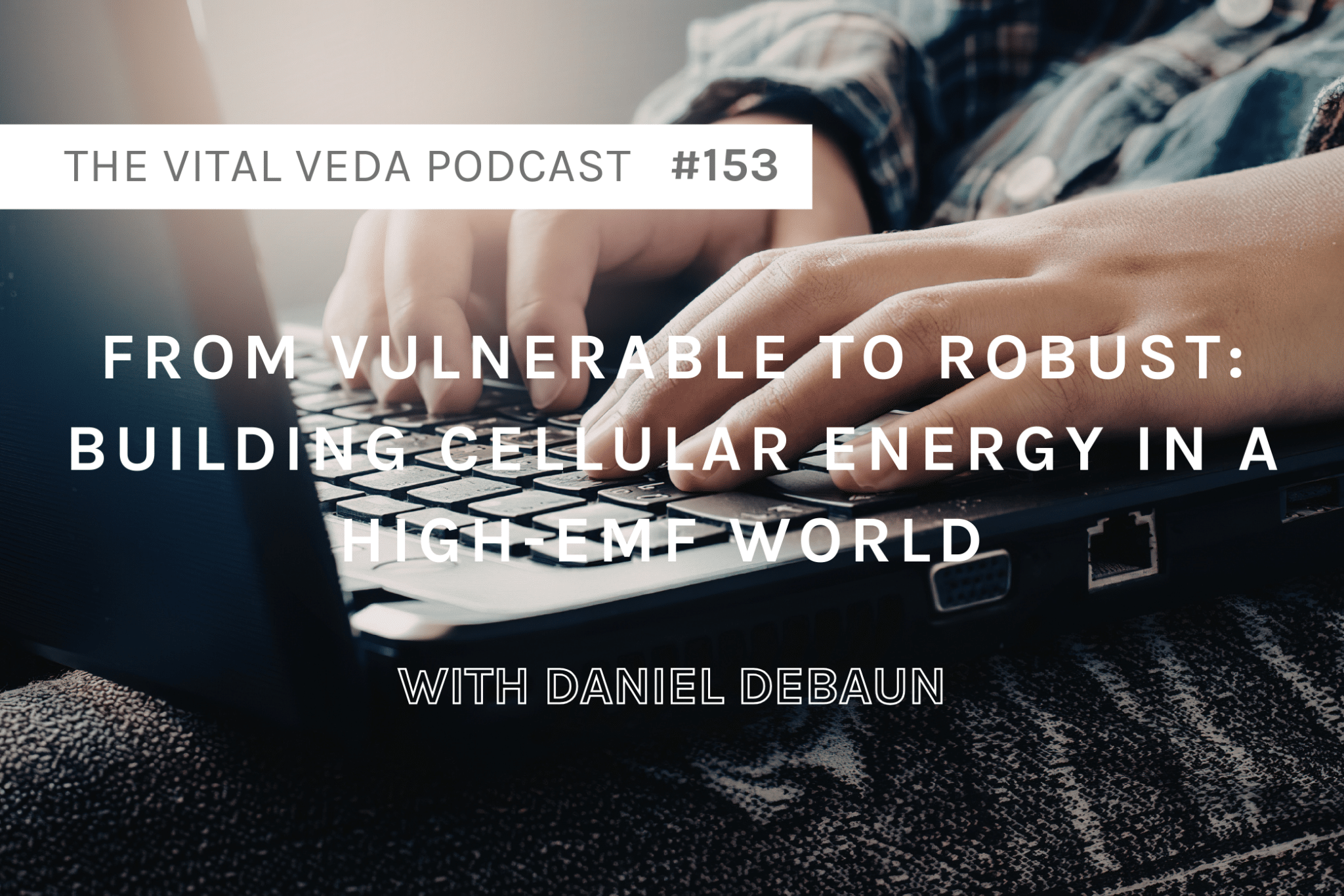
We are electrical beings.
Every heartbeat, nerve impulse and cellular signal depends on electrical gradients. Yet modern life surrounds us with artificial electromagnetic fields from mobile phones, laptops, WiFi routers and wireless infrastructure.
So the question is no longer whether EMF exists. The real question is how these signals interact with human biology and how we can build resilient cellular energy in an increasingly high-EMF world.
In this episode of the Vital Veda Podcast, Dylan Smith sits down with telecommunications engineer and EMF expert Daniel DeBaun to unpack the science behind electromagnetic fields, how they may influence cellular function, and what practical steps we can take to reduce exposure.
Daniel spent over 30 years inside the telecommunications industry helping design and test wireless infrastructure. But after years working with electromagnetic systems, his attention shifted toward the biological effects of chronic EMF exposure.
Together, Dylan and Daniel explore the intersection between technology, biology and resilience. From the mechanics of electromagnetic radiation to mitochondrial health and oxidative stress, this conversation dives into the science of how our modern environment may influence cellular energy.
More importantly, it focuses on solutions. Rather than creating fear, this episode explores how awareness, intelligent technology use and simple protective strategies can help us stay robust in a rapidly evolving digital world.
Daniel T. DeBaun is a telecommunications engineer with more than three decades of experience designing and testing wireless infrastructure.
During his career he worked inside the systems that power modern telecommunications, including overseeing electromagnetic interference testing laboratories and helping establish technical standards for wireless technologies.
Over time, his focus shifted toward the biological implications of electromagnetic radiation from everyday devices such as mobile phones, laptops and tablets.
Daniel went on to found DefenderShield, a company developing technology designed to reduce personal EMF exposure. He is also co-author of the book Radiation Nation: The Fallout of Modern Technology, which explores EMF awareness and practical protective strategies.
Today Daniel speaks globally about EMF exposure, helping bridge the gap between engineering knowledge and biological understanding.

Electromagnetic fields (EMFs) are invisible areas of energy produced by electrically charged objects. In today’s digital world they are generated by a wide range of technologies including mobile phones, laptops, WiFi routers, Bluetooth devices and wireless infrastructure.
EMFs exist across a spectrum of frequencies. At one end of the spectrum are extremely high-energy waves such as X-rays and gamma rays. These forms of radiation are known as ionising radiation because they have enough energy to remove electrons from atoms and directly damage DNA.
Most consumer electronics, however, emit non-ionising radiation, which includes radiofrequency (RF) and microwave radiation. These signals do not have enough energy to ionise atoms, but researchers continue to study how long-term exposure may interact with biological systems.
In modern environments, humans are exposed to significantly more electromagnetic radiation than previous generations. While our bodies naturally operate through electrical signalling, questions are increasingly being asked about how constant exposure to artificial electromagnetic fields may influence cellular processes.
Understanding the difference between ionising and non-ionising radiation is essential when discussing electromagnetic exposure.
Ionising radiation carries enough energy to remove electrons from atoms, creating charged particles known as ions. This type of radiation can directly damage DNA and includes sources such as X-rays, gamma rays and certain forms of nuclear radiation.
Non-ionising radiation, on the other hand, does not carry enough energy to ionise atoms. This category includes radiofrequency (RF) radiation, microwaves, infrared radiation and visible light. Wireless communication technologies such as mobile phones, WiFi routers and Bluetooth devices operate within this non-ionising range.
Although non-ionising radiation does not break chemical bonds in the same way as ionising radiation, researchers are investigating whether long-term exposure to electromagnetic fields may influence biological systems through other mechanisms, such as electrical changes in cell membranes or oxidative stress pathways.
Human physiology relies heavily on electrical signalling. Every nerve impulse, heartbeat and muscle contraction depends on electrical gradients across cell membranes. Even at the cellular level, communication between cells is influenced by electrical and biochemical signals.
Inside each cell is a fluid environment called the cytoplasm, which contains structured water, proteins and organelles responsible for metabolism and energy production. The integrity of this environment plays an important role in maintaining healthy cellular communication.
Some researchers propose that electromagnetic fields may influence cellular function by interacting with electrical properties of cell membranes or altering signalling pathways within cells. These potential interactions are still being studied, but emerging models suggest that certain electromagnetic frequencies may influence cellular signalling mechanisms that regulate calcium ions, oxidative stress and mitochondrial function.
Because calcium signalling is involved in many essential biological processes, any disruption to these pathways could have widespread effects on metabolism, repair and cellular resilience.
One of the proposed biological mechanisms linking electromagnetic exposure to cellular effects involves voltage-gated calcium channels (VGCCs).
VGCCs are specialised protein channels located in cell membranes. These channels open when the electrical voltage across the membrane changes, allowing calcium ions (Ca²⁺) to flow into the cell. Calcium is one of the most important signalling molecules in human biology.
Calcium ions regulate many critical processes including neurotransmitter release, muscle contraction, hormone secretion, gene expression and immune system activation. They also play an important role in mitochondrial metabolism and cellular energy production.
Under normal conditions, cells maintain extremely low levels of calcium inside the cell compared to outside. This gradient is tightly controlled because even small increases in calcium concentration can trigger powerful signalling cascades.
Some researchers have proposed that electromagnetic fields may influence the electrical sensors on VGCCs, potentially causing them to open more frequently. When this occurs, excess calcium can enter the cell and initiate downstream signalling events that may increase oxidative stress and affect cellular metabolism.
This hypothesis is often referred to as the VGCC oxidative stress model.
Mitochondria are the energy-producing structures within cells, responsible for generating ATP, the primary energy currency of the body. Healthy mitochondrial function is essential for metabolism, tissue repair, immune function and overall vitality.
In the proposed VGCC pathway, excessive calcium influx can trigger the production of reactive oxygen species (ROS) and other oxidative molecules. Increased oxidative stress may influence cellular membranes, proteins and DNA.
Some models suggest that elevated calcium levels can also affect mitochondrial membranes, potentially disrupting normal energy production. When mitochondrial function declines, ATP production may decrease and cells may struggle to maintain optimal repair and metabolic signalling.
Over time, oxidative stress is associated with accelerated cellular ageing and may contribute to the development of chronic disease.
While research in this area continues to evolve, the connection between cellular energy, mitochondrial health and environmental exposures is an emerging area of scientific interest.
Modern wireless technologies rely on radiofrequency radiation to transmit data between devices and communication networks. Mobile phones, tablets, laptops and wireless routers all emit varying levels of radiofrequency electromagnetic fields.
Mobile phones are one of the most common sources of personal EMF exposure because they are often held close to the body. Radiofrequency radiation from mobile devices can penetrate several centimetres into biological tissue, depending on the frequency and power level.
Because of widespread usage, mobile phone exposure has been studied extensively in relation to long-term health outcomes. Some discussions around wireless technology also intensified with the global rollout of 5G networks, which use a combination of existing and higher frequency bands to increase data transmission speed.
At the same time, international agencies such as the World Health Organization have classified radiofrequency radiation as a Group 2B possible carcinogen, a category that includes substances where evidence of cancer risk remains limited or under investigation.
As technology continues to evolve, many experts emphasise the importance of ongoing research and informed awareness around electromagnetic exposure.
Although electromagnetic technologies are deeply integrated into modern life, there are several practical steps that can significantly reduce personal exposure.
One of the most important principles is distance. Electromagnetic radiation decreases rapidly as distance from the source increases. Even moving a device one to two feet away from the body can substantially reduce exposure.
Using speakerphone or air-tube headsets instead of holding a phone directly to the ear can also minimise radiofrequency exposure to the head. Activating airplane mode when connectivity is not needed disables cellular, WiFi and Bluetooth signals.
It is also recommended to avoid placing laptops directly on the body for prolonged periods, as devices may emit radiation from multiple components including the keyboard, screen and internal antennas.
These simple habits allow people to continue using modern technology while taking practical steps to minimise unnecessary electromagnetic exposure.
Enjoyed this episode? Explore more conversations on technology, environment and health.
EMF, 5G & Building Biology | Nicole Bijlsma #019
EMF Expanded: Geo-Electric & Human Generated Radiation | Gerard Bini #085
The Light Diet, Quantum Health & Circadian Rhythms | Matt Maruca #021
Please leave me a comment below (I love to read every single one).


Special thanks to Rudolf Steiner and Jiddu Krishnamurti for providing content.


Time tested wisdom & an integrated healing community for you.
We pay our respects to the traditional custodians and caretakers of the lands on which we treat, teach, work and live. Vital Veda headquarters work on Bundjalung country which is now commonly known as Byron Shire, Northern Rivers NSW Australia. We also frequently work on Gadigal land, now known as Sydney, Australia. We recognise the traditional custodians have never ceded sovereignty and their culture remains strong and holds supreme wisdom for all of humanity to enjoy.
*This information and these statements have not been evaluated by the Therapeutic Goods Association or the Food and Drug Administration. This information and these products are not intended to treat, diagnose, cure or prevent any disease.
Disclaimer: The entire contents of this website are based upon the opinions of Dylan Smith. This information is in no way to be construed as a substitute for consultation with a licensed health professional. It is not intended as medical advice. They are intended as sharing of knowledge and information from the research and experience of Dylan Smith and his community. Dylan Smith encourages you to make your own health care decisions based upon your research and in partnership with a qualified health care professional.
© 2026 – Vital Veda. All Rights Reserved.
Occasionally get notified about new offerings, special deals, wisdom and more
Occasionally get notified about new offerings, special deals, wisdom and more
Occasionally get notified about new offerings, special deals, wisdom and more
Occasionally get notified about new offerings, special deals, wisdom and more